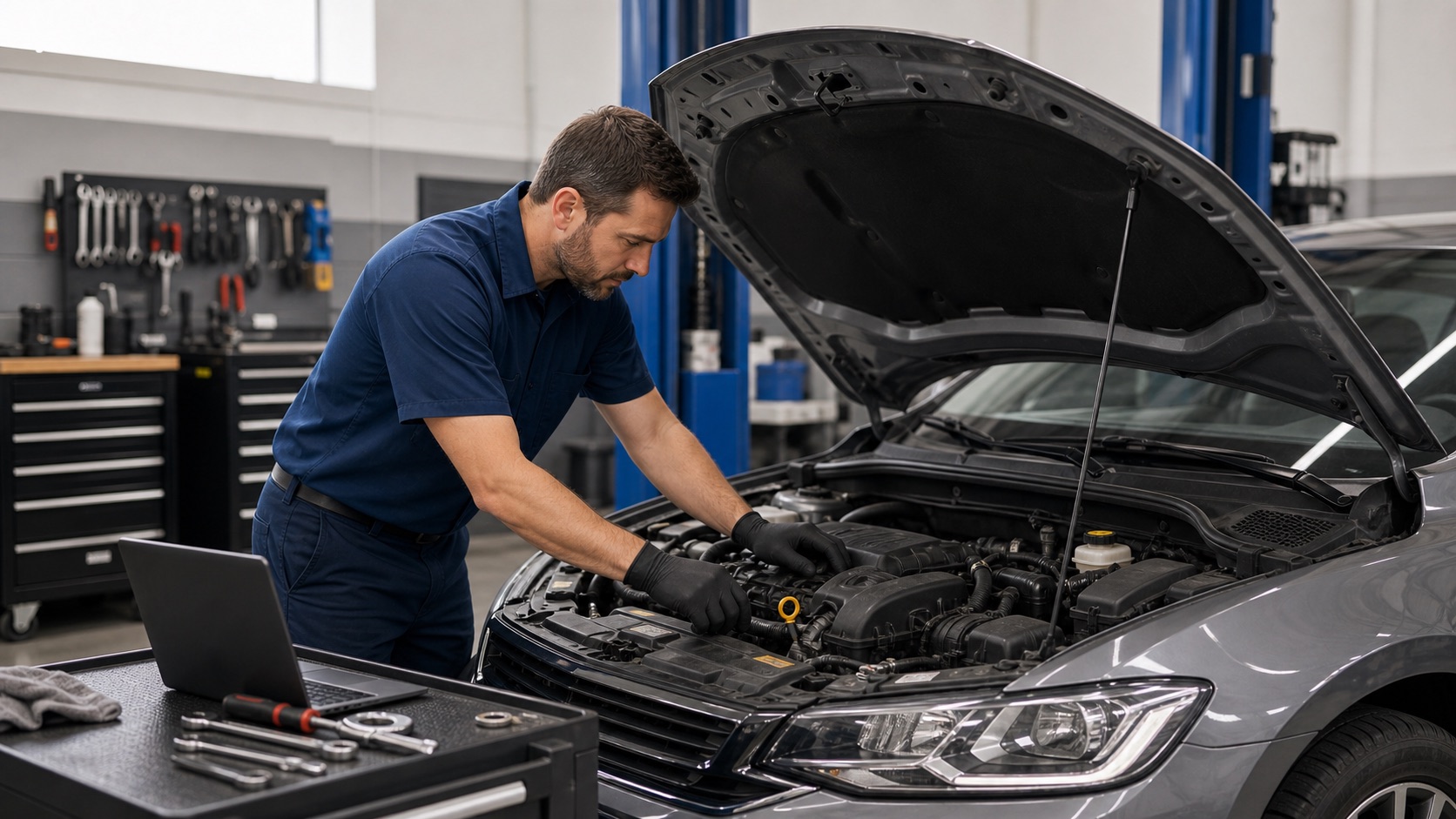
Most common car repairs cost between $150 and $1,500 in 2026, with shop labor running $100 to $200+ per hour. Routine jobs like an oil change or battery stay under $250, mid-range repairs like brakes or an alternator run $300–$1,000, and major work like a transmission rebuild can exceed $3,000–$6,000.
This pillar guide breaks down average 2026 prices for every common repair, explains why labor rates are what they are, and shows you how to avoid overpaying — whether you use a dealership, an independent shop, or a national chain.
How Much Does Car Repair Cost in 2026?
| Repair | Typical Cost (Parts + Labor) |
|---|---|
| Oil change | $45 – $130 |
| Car battery | $150 – $400 |
| Wheel alignment | $75 – $200 |
| Brake repair | $250 – $850 per axle |
| Tire replacement | $150 – $400+ per tire |
| Car AC repair | $200 – $1,500 |
| Alternator replacement | $400 – $1,000 |
| Timing belt | $500 – $1,500 |
| Catalytic converter | $900 – $2,500 |
| Transmission repair | $1,200 – $6,000+ |
| Diagnostic fee | $75 – $200 |
Where these numbers come from: Ranges reflect 2026 national averages built on shop labor rates of $100–$200+/hour. The U.S. Bureau of Labor Statistics (May 2025 Occupational Employment and Wage Statistics) reports automotive service technicians earn a median of roughly $24/hour — shops then add overhead, equipment, insurance, and margin, which is how a $24/hour wage becomes a $150/hour door rate.
Why Do Shops Charge $100–$200 Per Hour?
The gap between a technician’s wage and the rate on your invoice isn’t gouging — it’s shop economics:
- Technician pay — per BLS data, the median tech earns about $24/hour, and experienced, certified techs earn well above that.
- Overhead — lifts, diagnostic scan tools, software subscriptions, rent, utilities, and liability insurance all get baked into the hourly rate.
- Certification — shops employing ASE-certified technicians invest in ongoing training and testing, which commands higher (and usually better-value) rates.
- Book time — most repairs are billed by standardized flat-rate hours, not the clock, so a fast tech doesn’t lower your bill and a slow one doesn’t raise it.
For a deeper dive, see our guide to how much a mechanic costs per hour.
What Determines Your Car Repair Cost?
- The repair itself — batteries and oil changes are cheap; transmissions, engines, and anything behind the dashboard are not.
- Your vehicle’s make — European brands (BMW, Mercedes, Audi, Volvo) typically cost 30–50% more to repair than Toyota, Honda, or Ford, due to pricier parts and specialized procedures.
- OEM vs. aftermarket parts — original-equipment parts can cost 2x quality aftermarket equivalents; for many repairs, reputable aftermarket parts perform identically.
- Labor rate and shop type — dealerships charge the most, independents the least, chains in between.
- Your region — urban and coastal markets run higher. See our Los Angeles car repair cost guide for a high-cost-market example.
- Diagnostic complexity — intermittent electrical faults take more billable hours to find than a worn brake pad.
Dealership vs. Independent vs. Chain: Which Is Cheapest?
| Shop Type | Labor Rate | Best For | Watch Out For |
|---|---|---|---|
| Dealership | $150 – $250+/hr | Warranty work, recalls, complex electronics | Highest rates, OEM-only parts |
| Independent shop | $100 – $160/hr | Most out-of-warranty repairs | Quality varies — vet the shop |
| National chain | $90 – $150/hr | Tires, brakes, oil, batteries | Upsells on flushes and add-ons |
For most out-of-warranty repairs, a good independent shop offers the best value — often 20–40% less than a dealer for the same job. The AAA approved-repair network and ASE certification logos are useful quality signals. See how to find a good mechanic near you for a full vetting checklist.
What Should a Diagnostic Fee Cost?
Expect $75–$200 for a proper diagnostic, and treat it as money well spent. A check engine light can mean anything from a loose gas cap to a failing catalytic converter — guessing at parts is far more expensive than paying for an hour of diagnosis. Two norms to know:
- Many shops credit the diagnostic fee toward the repair if you approve the work — ask before authorizing.
- A free code scan at a parts store reads the code but doesn’t diagnose the cause. A code pointing at an oxygen sensor doesn’t always mean the sensor is bad.
If your car is showing symptoms, review the signs your car needs repair before they escalate.
How Can You Save on Car Repairs?
- Get 2–3 written quotes for any repair over $500 — prices for the same job routinely vary by hundreds of dollars.
- Use an independent shop for out-of-warranty work and reserve the dealer for warranty claims and recalls (check yours free at NHTSA).
- Approve a diagnostic first, then decide — never authorize open-ended work.
- Ask about quality aftermarket parts to cut the parts bill 20–50% on many jobs.
- Keep up with maintenance — regular oil changes and fluid services prevent four-figure failures.
- Vet the shop before you’re stranded — see questions to ask a mechanic.
Frequently Asked Questions
How much do car repairs cost on average? Most common repairs run $150–$1,500 with parts and labor. Minor jobs (battery, oil change) stay under $250, while major repairs like transmission rebuilds can exceed $3,000–$6,000.
How much do mechanics charge per hour in 2026? Shop labor rates run $100–$200+ per hour, with dealerships at the top of the range. Technicians themselves earn a median of about $24/hour per BLS data; overhead makes up the difference. See mechanic rates.
Is a dealership or independent mechanic cheaper? Independent shops are usually 20–40% cheaper for out-of-warranty repairs. Dealerships make sense for warranty work, recalls, and brand-specific electronic issues.
What is the most expensive common car repair? Transmission and engine work top the list at $1,200–$6,000+, followed by catalytic converters ($900–$2,500) and major AC repairs.
Should I repair my car or replace it? A common rule: if a single repair exceeds 50% of the car’s market value — or you’re facing repeated major repairs — replacement is usually smarter. Get a diagnosis and written quote before deciding.
Sources: U.S. Bureau of Labor Statistics, Occupational Employment and Wage Statistics, May 2025 · National Institute for Automotive Service Excellence (ASE) · National Highway Traffic Safety Administration (NHTSA) · AAA Car Care
Last updated: June 2026. National averages for informational purposes; always get a written estimate from a licensed mechanic.