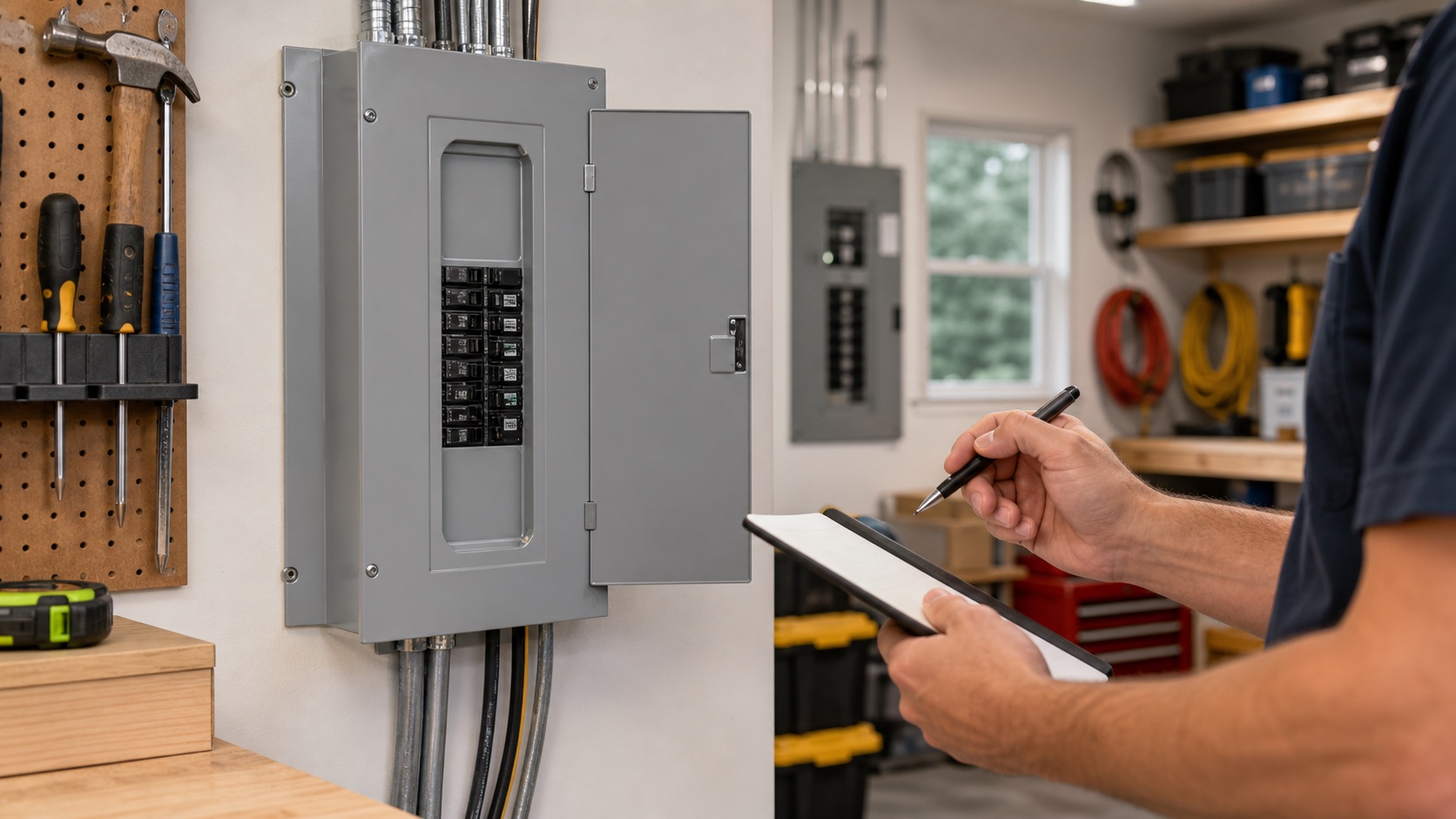
A subpanel is the right fix when your main panel is out of breaker slots or you need to distribute power to a separate area like a garage, addition, or shop — but it’s the wrong fix if your home is out of actual service capacity, because a subpanel adds slots, not amps. That distinction trips up a lot of homeowners. Here’s when a subpanel solves your problem, when you really need a service upgrade instead, and what each costs.
Subpanel vs. Service Upgrade (The Key Difference)
- A subpanel is fed from your main panel and provides more breaker spaces and a convenient distribution point. It does not increase your home’s total electrical capacity.
- A service upgrade (e.g., 100A → 200A) increases the total amps your home can draw from the utility.
So: out of slots but have capacity → subpanel. Out of capacity → upgrade (often 200A service upgrade).
When a Subpanel Makes Sense
| Scenario | Why a subpanel fits |
|---|---|
| Main panel full (no open slots), capacity remains | Adds breaker spaces |
| Detached garage / shop / ADU | Distributes power efficiently to a remote area |
| Home addition / finished basement | Local breakers for the new space |
| Workshop with several 240V tools | Dedicated, organized circuits |
| Reduce long wire runs | Place breakers closer to the loads |
When You Need an Upgrade Instead
A subpanel won’t help if you’re already maxing your service. Signs you need a service upgrade, not just a subpanel:
- Frequent main-breaker trips, whole-house flickering under load.
- Adding big loads (EV charger, electric range, hot tub, heat pump) and a load calculation exceeds your service.
- An old 100A panel with modern all-electric demands.
- An obsolete/unsafe panel like a Federal Pacific — upgrade, don’t extend it.
A load calculation tells you which path you need.
Costs
| Work | Typical cost |
|---|---|
| Subpanel (nearby, modest) | $500 – $1,500 |
| Subpanel to detached structure (trenching/feeder) | $1,500 – $4,000+ |
| 200A service upgrade | $1,500 – $4,000+ |
| Permit + inspection | Often required (permit guide) |
Subpanel work needs proper feeder sizing, grounding/bonding (separated in a subpanel), and a permit — definitely an electrician job. Sanity-check quotes via questions to ask an electrician and panel replacement cost.
Frequently Asked Questions
What is a subpanel and what does it do? A subpanel is a smaller breaker panel fed from your main panel. It provides additional breaker spaces and a local point to distribute power — useful for a garage, addition, workshop, or detached structure. Importantly, it does not increase your home’s total electrical capacity; it just gives you more circuits and shortens wire runs to a specific area.
Do I need a subpanel or a service upgrade? Use a subpanel when your main panel is out of breaker slots but you still have spare service capacity, or when you need to power a separate area like a garage. Get a service upgrade when a load calculation shows your home needs more total amps — for example when adding an EV charger, electric range, or heat pump to an already-loaded panel.
Can I add a subpanel to a 100-amp panel? You can, if a load calculation shows your home isn’t already near its 100A capacity, since a subpanel adds slots, not amps. But if you’re adding significant new loads or the panel is frequently maxed, a 100A service often needs upgrading to 200A instead. An electrician’s load calc determines whether a subpanel is enough.
How much does it cost to install a subpanel? A nearby subpanel typically runs $500–$1,500, while feeding a detached garage or structure (with trenching and a long feeder) can be $1,500–$4,000 or more. That’s comparable to a 200A service upgrade, so it’s worth confirming which one actually solves your problem before committing. Permits and inspection are usually required.
Does a subpanel need a permit? In most jurisdictions, yes — installing a subpanel involves new feeder wiring, breakers, and grounding/bonding that must meet code, so it requires a permit and inspection. Use a licensed electrician, since subpanels also have specific rules (like separating the neutral and ground bars) that differ from the main panel and matter for safety.
Last updated: June 17, 2026. Sources: NFPA National Electrical Code on subpanels, feeders, and grounding/bonding; ESFI electrical capacity safety; 2026 cost ranges per our electrical guides. Subpanel and feeder work requires a licensed electrician and permit.