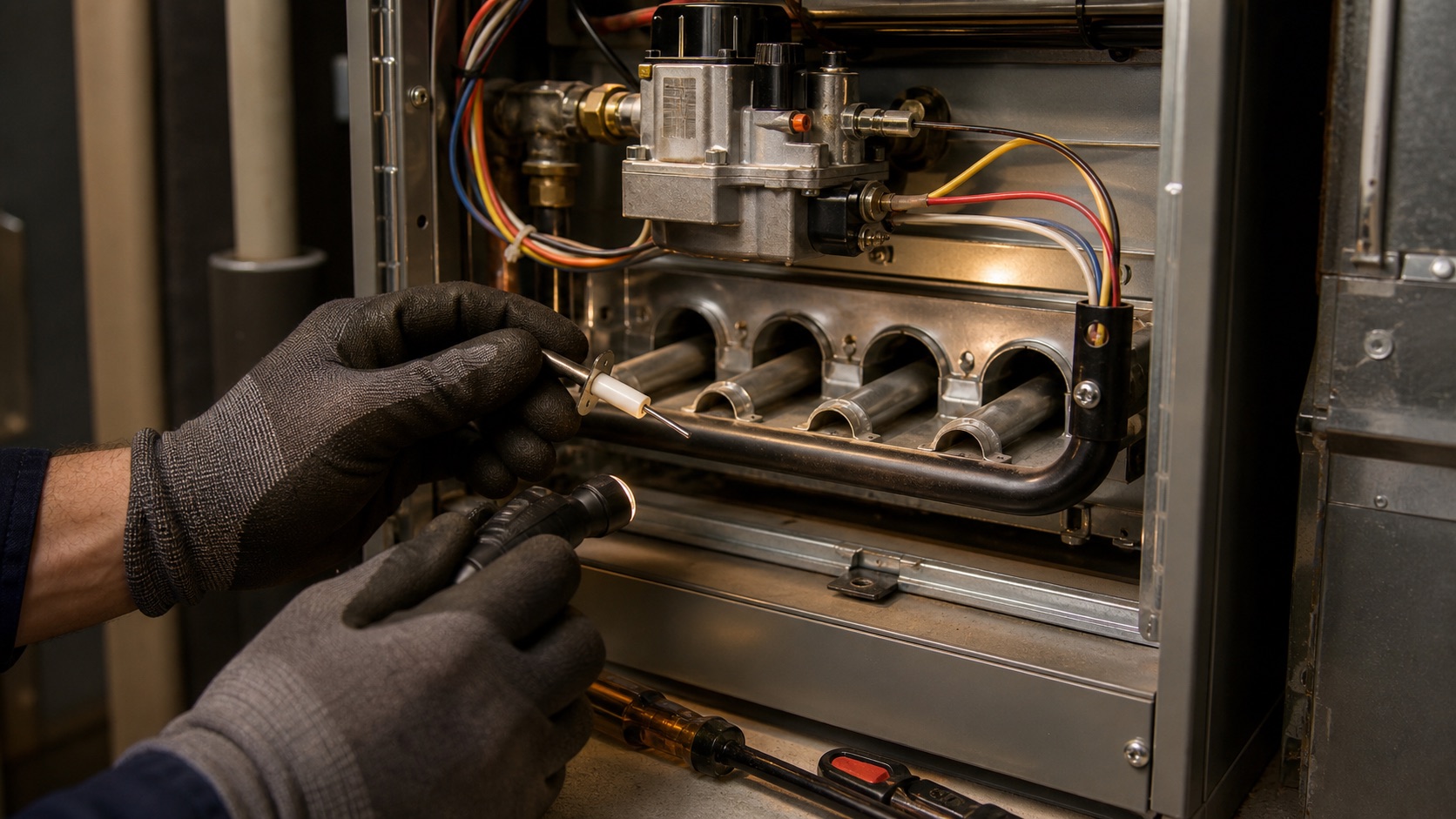
When a furnace tries to start but won’t light, the most common culprits are a cracked or worn-out hot surface igniter, a dirty flame sensor, or an interrupted gas supply — and the igniter is a wear part that fails after years of heating cycles. Modern furnaces don’t have a standing pilot; they use an electronic igniter that glows hot to light the burner. If it’s not glowing, not lighting, or lighting then shutting off, here’s how to narrow it down — and what’s safe to DIY versus a pro call.
How Modern Ignition Works
Most furnaces built since the 1990s use a hot surface igniter (HSI) — a small element that glows orange-hot to ignite the gas — or an intermittent spark igniter. A flame sensor then confirms the flame is present; if it doesn’t, the furnace shuts the gas off for safety. So “won’t ignite” can be the igniter or the sensor.
Read the Symptom
| Symptom | Likely cause |
|---|---|
| Clicks, no glow, no light | Failed hot surface igniter, control board, or no power to igniter |
| Igniter glows but no flame | Gas supply issue, gas valve, or clogged burner |
| Lights then shuts off in seconds | Dirty flame sensor (very common) |
| Nothing at all | Power, thermostat, door safety switch, or blown fuse on the board |
A furnace that lights then dies seconds later is the classic dirty flame sensor — often just needs cleaning.
What You Can Check (Safely)
- Power and thermostat — breaker on, thermostat calling for heat, batteries good.
- Furnace door switch — the panel must be fully seated; many furnaces won’t run with it off.
- Filter and vents — a severe airflow problem can trip safeties (furnace short cycling).
- Reset — cycle power at the switch/breaker once.
- Smell gas? Stop. Leave and call the gas company — don’t troubleshoot (furnace not working emergency).
Hot surface igniters are fragile (don’t touch the element — skin oils damage them) and gas/electrical work is best left to a pro beyond these basics.
What Needs a Pro — and Cost
A technician will test the igniter’s resistance, clean or replace the flame sensor, check the gas valve and pressure, and inspect the control board.
| Work | Typical cost |
|---|---|
| Flame sensor clean/replace | $80 – $250 |
| Hot surface igniter replacement | $150 – $400 |
| Gas valve replacement | $300 – $700 |
| Control board | $300 – $700 |
| Diagnostic visit | $75 – $200 |
If it’s an old furnace with stacking repairs, weigh repair or replace and price replacement with furnace replacement cost; sanity-check any quote via HVAC quote seems high.
Frequently Asked Questions
Why won’t my furnace ignite? The usual causes are a worn-out or cracked hot surface igniter, a dirty flame sensor that shuts the gas off after lighting, or an interrupted gas supply. Less commonly it’s the control board, gas valve, or a safety like the door switch. The exact symptom — no glow, glow but no flame, or lights then dies — points to which.
My furnace igniter glows but the burner won’t light — why? That usually points to a gas-side problem: the gas supply or valve isn’t delivering fuel, or the burners are clogged. The igniter is working (it glows), so the issue is getting gas to ignite. This needs a technician to check gas pressure and the valve; if you smell gas, stop and call the gas company.
Why does my furnace light then shut off after a few seconds? That’s the classic sign of a dirty flame sensor. The sensor must detect the flame within seconds or the control board shuts the gas off for safety. Cleaning or replacing the sensor — an inexpensive fix — usually resolves it. Repeated shutoffs with a clean sensor warrant a fuller diagnosis.
Can I replace a furnace igniter myself? Hot surface igniters are cheap but fragile — touching the element with bare fingers can ruin it — and the job involves gas equipment and electrical connections. Basic checks (power, door switch, filter, reset) are fine, but igniter, sensor, and gas-valve work is safest with a technician, especially given carbon monoxide and gas risks.
How much does it cost to fix a furnace that won’t ignite? Cleaning or replacing a flame sensor runs about $80–$250, a hot surface igniter $150–$400, and a gas valve or control board $300–$700. A diagnostic visit is typically $75–$200. If an aging furnace needs repeated repairs, compare those costs against replacement before spending more.
Last updated: June 16, 2026. Sources: ENERGY STAR furnace maintenance guidance; CPSC on gas furnaces and carbon monoxide safety; 2026 cost ranges per our HVAC guides. If you smell gas, leave and call for help.