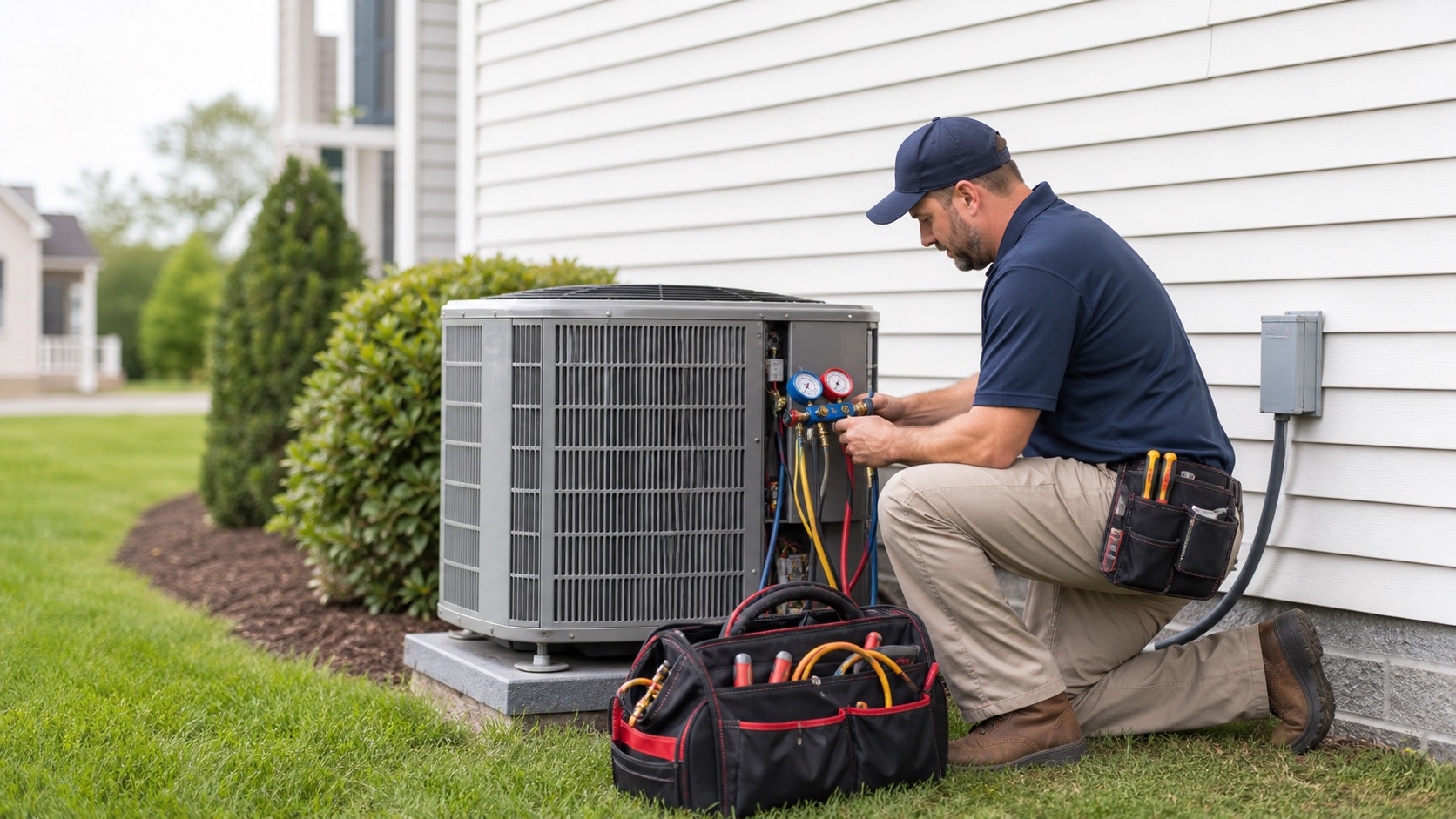
Most homeowners pay between $150 and $450 for a typical HVAC repair, with a national average of around $350. Simple fixes like a capacitor replacement can cost as little as $75, while major repairs such as a compressor or heat exchanger replacement can run $1,200 to $2,500 or more. This guide breaks down exactly what you’ll pay for the most common HVAC problems in 2026, what affects the price, and how to avoid overpaying.
HVAC Repair Cost at a Glance
| Repair | Typical Cost Range | Average |
|---|---|---|
| Refrigerant recharge | $200 – $600 | $375 |
| Capacitor replacement | $75 – $250 | $170 |
| Contactor replacement | $90 – $300 | $200 |
| Thermostat replacement | $110 – $350 | $230 |
| Blower motor replacement | $300 – $1,000 | $600 |
| Condensate drain cleaning | $75 – $250 | $150 |
| Evaporator coil replacement | $600 – $2,000 | $1,200 |
| Compressor replacement | $1,200 – $2,800 | $1,900 |
| Heat exchanger replacement | $1,100 – $2,500 | $1,800 |
| Refrigerant leak repair | $225 – $1,600 | $700 |
Note: Prices include parts and labor and reflect 2026 national averages. Your local rates may be 10–25% higher in major metro areas. See our city-specific guides for HVAC repair cost in Houston, Phoenix, and Dallas.
Where these numbers come from: We compare published national market ranges and use the latest U.S. Bureau of Labor Statistics HVAC wage data as labor-market context. A technician’s wage is not the same as the retail rate on your invoice, which also reflects travel, diagnosis, insurance, equipment, warranty risk, parts, overhead, and local demand.
What Determines Your HVAC Repair Cost?
Several factors push your final bill up or down:
- The component that failed. Electrical parts (capacitors, contactors) are cheap. Sealed-system parts (compressor, coils) are expensive because they require refrigerant handling and more labor.
- Labor rates in your area. HVAC companies commonly bill $75–$150 per hour, plus a $75–$200 service/diagnostic fee. Compare that retail rate with local quotes, not directly with an employee wage; the two measure different things.
- Refrigerant type. Older R-22 systems are far more expensive to recharge than modern R-410A or R-454B systems, because R-22 is being phased out.
- Emergency vs. scheduled. After-hours, weekend, or holiday calls add 50–100% to labor. See our emergency AC repair cost guide.
- Warranty status. If your system is under manufacturer warranty, parts may be free — you’d only pay labor.
The Most Common HVAC Repairs (and What They Cost)
1. Refrigerant Recharge — $200 to $600
If your AC runs but doesn’t cool, low refrigerant is a common culprit. But remember: refrigerant doesn’t get “used up.” If it’s low, you have a leak that also needs fixing — otherwise you’ll be recharging again next season. Learn the warning signs in our guide on signs your AC needs repair.
2. Capacitor Replacement — $75 to $250
The capacitor gives your motor the jolt it needs to start. A failed capacitor is one of the cheapest and most common repairs, and it’s often why an AC unit hums but won’t start.
3. Blower Motor Replacement — $300 to $1,000
The blower motor pushes air through your ducts. Variable-speed (ECM) motors cost more than standard PSC motors. If your furnace is blowing cold air or airflow is weak, this could be the issue.
4. Compressor Replacement — $1,200 to $2,800
The compressor is the heart of your AC. Replacing it is one of the most expensive repairs, which is why a failed compressor often pushes homeowners toward replacing the whole unit. We break down that math in when to repair vs. replace your HVAC.
5. Heat Exchanger Replacement — $1,100 to $2,500
A cracked heat exchanger in a furnace is a safety issue (carbon monoxide risk). Because the part is costly and labor-intensive, many techs recommend replacing the furnace if it’s over 12–15 years old.
Repair vs. Replace: Use a Screening Test, Not a Magic Formula
A repair approaching 50% of a comparable replacement quote is a useful signal to compare both options, especially on an older, out-of-warranty system. It is not a universal industry rule. Climate, efficiency gains, refrigerant type, warranty coverage, and whether the diagnosis is certain can change the decision.
Before replacing, get the failed component and diagnostic readings in writing, check the manufacturer warranty, and seek a second opinion on compressor or heat-exchanger diagnoses. Compare the repair with a like-for-like replacement quote rather than a premium system loaded with optional upgrades.
For a full walkthrough, read when to repair vs. replace your HVAC and how long an AC unit lasts.
How to Save Money on HVAC Repairs
- Get 2–3 quotes for any repair over $500. Prices vary widely between contractors.
- Schedule routine maintenance ($100–$300/year) to catch small problems early. See how often HVAC should be serviced.
- Ask about flat-rate vs. hourly pricing before work begins.
- Avoid emergency calls when possible — wait for regular hours.
- Check your warranty before paying for parts.
- Vet your contractor. Use our questions to ask an HVAC contractor before hiring.
How to Find a Reliable HVAC Technician Near You
Cost matters, but so does quality. A cheap repair done wrong costs more later. Look for licensed, insured, NATE-certified technicians with strong local reviews. Our full guide on how to find a good HVAC technician near you walks through exactly what to check.
Frequently Asked Questions
How much does it cost to have an HVAC technician come out? Most companies charge a service or diagnostic fee of $75 to $200, which is sometimes waived if you proceed with the repair.
Is it worth repairing a 15-year-old HVAC system? Usually not, if the repair is major. Systems over 12–15 years old are near the end of their lifespan and less efficient. A large repair is often better spent toward a replacement.
Why is my AC running but not cooling? Common causes include low refrigerant, a dirty filter, a failed capacitor, or a frozen coil. See our full troubleshooting guide on AC not cooling but running.
Does homeowners insurance cover HVAC repair? Typically only if the damage is caused by a covered event (like a fire or storm) — not normal wear and tear or age-related breakdowns.
How often should I service my HVAC system? At least once a year — ideally the AC in spring and the furnace in fall. Read how often HVAC should be serviced.
Last updated: June 10, 2026. Prices are national averages cross-referenced with BLS wage data (May 2025) and national cost aggregators; they may vary by location and contractor. Always get a written quote before authorizing repairs.