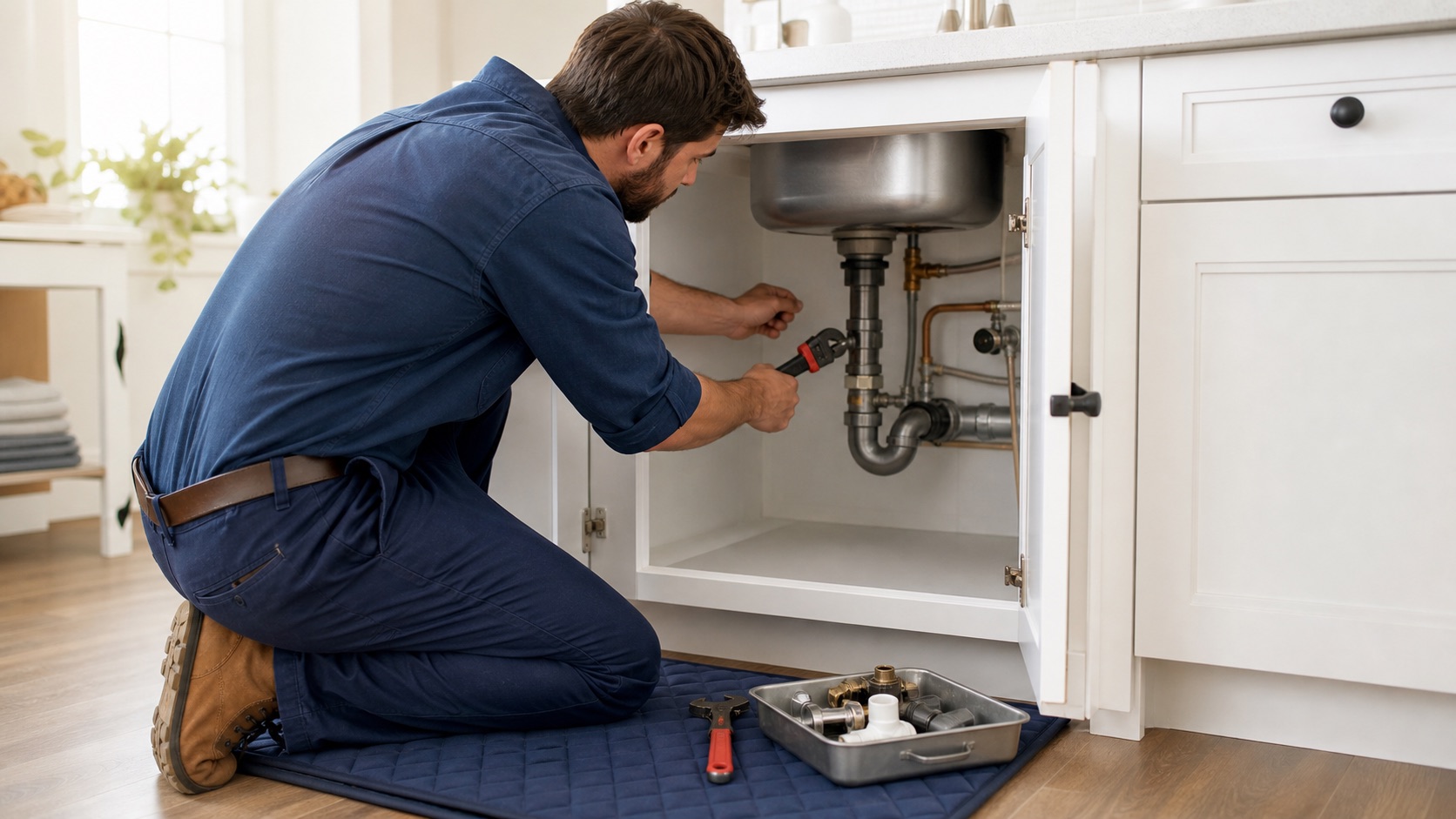
Most plumbers charge between $45 and $200 per hour, and the typical residential plumbing job costs $175 to $480 all-in. Simple fixes like a running toilet start around $125, while complex projects such as sewer-line or slab-leak repair can run $1,000 to $5,000+. Many plumbers now quote a flat rate per job rather than billing hourly, so always ask which model a company uses before work begins.
How Much Do Plumbers Charge? Quick-Reference Table
| Job | Typical Cost (2026) |
|---|---|
| Service call / minimum fee | $50 – $200 |
| Hourly rate | $45 – $200/hr |
| Unclog a drain | $150 – $450 |
| Fix a leaky faucet | $125 – $350 |
| Toilet repair | $130 – $400 |
| Toilet installation | $150 – $600 |
| Water heater repair | $150 – $700 |
| Water heater replacement | $900 – $3,500 |
| Drain cleaning | $150 – $800 |
| Burst pipe repair | $400 – $2,000 |
| Sewer line repair | $1,000 – $5,000+ |
| Slab leak repair | $630 – $4,400 |
Where these numbers come from: We compare published national market ranges and use Bureau of Labor Statistics plumbing wage data only as labor-market context. Employee wages do not convert directly into a customer rate; retail pricing also reflects travel, diagnosis, insurance, equipment, parts, warranty risk, overhead, and local demand.
Prices include parts and labor (2026 national averages). Local rates run 10–25 % higher in major metros — see our city guides.
Why Does a Plumber Cost So Much? The BLS Wage Multiplier Explained
A homeowner sees a $185/hr invoice and wonders why it’s so high when the median plumber earns $34.70/hr. Here’s what fills the gap:
| What the customer rate may cover | Why it varies |
|---|---|
| On-site and travel time | Distance, traffic, and minimum service windows |
| Payroll, insurance, and licensing | State rules and company structure |
| Truck, tools, and diagnostic equipment | Job type and equipment required |
| Office, dispatch, warranty, and callbacks | Service model and guarantee terms |
| Parts and materials | Brand, availability, and markup policy |
There is no single national markup or wage multiplier that every plumbing company uses. Flat-rate companies bundle these costs into a task price; hourly companies may list labor, trip fees, and parts separately. Compare the total written scope and warranty rather than trying to reverse-engineer an employee’s pay.
How Do Plumbers Charge: Flat-Rate vs. Hourly?
| Factor | Flat-Rate | Hourly |
|---|---|---|
| Price certainty | ✅ Know total before work starts | ❌ Final bill unknown until done |
| Risk of slow work | On the company | On you |
| Best for | Defined jobs (replacements, installs) | Diagnostic visits, time-and-material work |
| Savings potential | Lower if job is complex | Lower if job is very quick |
| Transparency | Moderate — markup is hidden in the rate | High — you see hours × rate |
Bottom line: flat-rate pricing protects you on standard jobs (faucet swap, toilet install). Hourly may save money on a 15-minute fix — but can balloon on surprises. Always ask for a not-to-exceed cap if paying hourly.
What Affects Your Plumbing Bill?
1. Job Complexity and Time
A straightforward faucet cartridge swap takes 30 minutes; rerouting a supply line behind drywall takes half a day. Complexity drives hours, parts, and risk.
2. Parts and Fixtures
A standard ball-cock valve costs $15; a commercial-grade backflow preventer runs $300+. Ask whether the quote includes brand-name or equivalent parts.
3. Accessibility
Work behind finished walls, under concrete slabs, or in crawl spaces adds time and specialized equipment (jackhammers, tunnel boring). Expect a 30–50 % premium over accessible pipe work.
4. Plumber Experience Level
| Level | Hourly Rate | Best For |
|---|---|---|
| Apprentice (1–3 yrs) | $45 – $90 | Assist roles, simple swaps |
| Journeyman (4–8 yrs) | $75 – $150 | Most residential jobs |
| Master plumber (8+ yrs) | $100 – $200 | Code-sensitive, complex |
Always verify your plumber’s license before authorizing work.
5. Emergency vs. Scheduled
After-hours, weekend, and holiday calls add 50–100 % to the bill. See our full emergency plumber cost guide.
6. Your City
Labor rates vary dramatically by metro. Plumbers in San Francisco bill 25–40 % more than the national median; those in smaller Southern and Midwestern cities often bill below it. Our city guides cover local pricing:
- Houston plumber cost
- Dallas plumber cost
- Phoenix plumber cost
What Are the Most Common Plumbing Jobs?
- Clogs and drain cleaning — See drain cleaning cost and try our DIY unclog guide first.
- Water heater issues — Compare repair vs. replacement costs.
- Leaking faucets and pipes — From a $125 cartridge swap to a $2,000 burst pipe repair.
- Toilet problems — Running toilets, wax-ring leaks, and full toilet installations.
- Sewer-line backups — The big one: $1,000–$5,000+ for sewer line repair.
How Can You Save Money on a Plumber?
- Get 2–3 flat-rate quotes for any job over $300 — prices for the same scope can vary 30 %.
- Bundle small jobs into one visit. A single trip fee covers multiple fixes.
- Try DIY for simple clogs — a $30 drain snake solves most sink blockages. See how to unclog a drain.
- Schedule during business hours to avoid emergency surcharges.
- Read the quote carefully — our guide on how to read a contractor quote helps you spot hidden fees.
- Ask about financing or membership plans for big-ticket jobs like water heater installs.
- Vet your plumber using questions to ask a plumber and how to find a good plumber near you.
How Much Should You Pay a Plumber Up Front?
A reasonable deposit is 10–25 % for large projects (repiping, sewer replacement) with the balance due on completion. For standard service calls, most plumbers collect payment after the work. Never pay 100 % before work begins. Read our contractor deposit guide for safe deposit practices.
Frequently Asked Questions
How much do plumbers charge per hour? $45–$200/hour depending on experience, location, timing, and the company’s pricing model. BLS wage data can help explain regional labor pressure, but it does not translate directly into a retail service rate.
Why do plumbers charge a service fee? The $50–$200 trip/service fee covers drive time, fuel, insurance, and initial diagnosis. Most companies credit it toward the repair if you proceed.
Is it cheaper to pay a plumber hourly or flat rate? Flat rate is usually safer — you know the total upfront and aren’t penalized for complications. Hourly can be cheaper only for very fast fixes (under 30 minutes).
What is the most expensive plumbing repair? Sewer line replacement ($1,000–$5,000+) and slab leak repair ($630–$4,400) top the list. See sewer line repair cost and slab leak repair cost.
Do plumbers charge more for emergencies? Yes — after-hours, weekend, and holiday calls add 50–100 %. See emergency plumber cost.
Sources
- Bureau of Labor Statistics — Occupational Employment and Wages, Plumbers (May 2025)
- EPA WaterSense — Water-Efficient Plumbing Fixtures
- ENERGY STAR — Federal Tax Credits for Home Improvements
Last updated: June 11, 2026. National averages for informational purposes; always get a written quote from a licensed plumber.