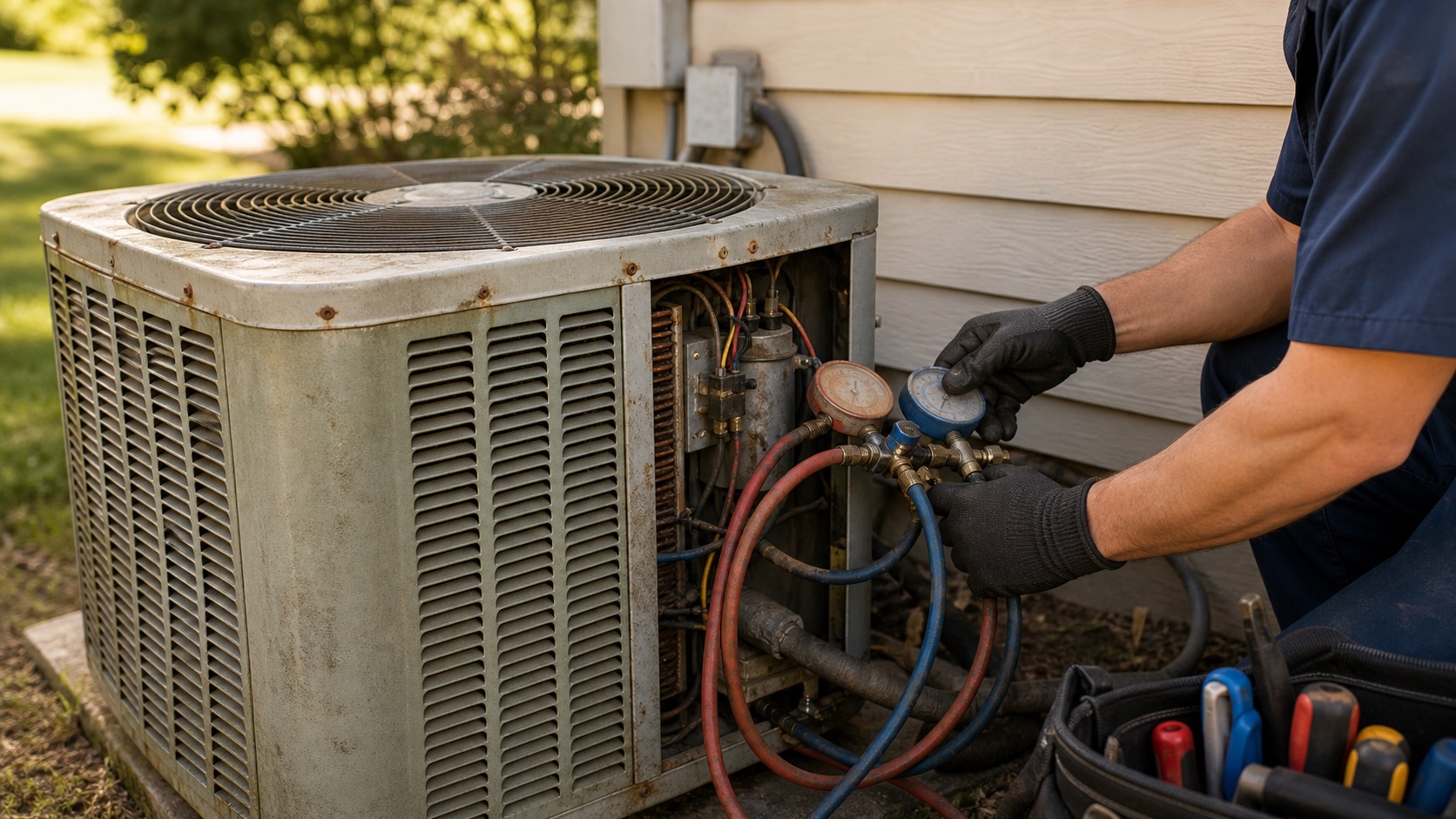
If you have an older AC that uses R-22 (the refrigerant sold as “Freon”) and it’s low on charge, the leak — not the refrigerant cost alone — is usually telling you to replace, not repair. R-22 production and import were banned in the U.S. on January 1, 2020, so the only supply left is recycled and reclaimed stock at steadily rising prices. Topping off an R-22 system that’s leaking is paying a premium to refill a tank with a hole in it. Here’s how to think it through.
Why R-22 Changes Everything
Under the Clean Air Act and the Montreal Protocol phaseout, the U.S. stopped producing and importing R-22 in 2020 because it’s ozone-depleting. What that means for you:
- No new R-22 — service relies on dwindling reclaimed supply.
- Recharge prices are high and volatile — often several hundred dollars per pound of refrigerant on top of labor, and a system can hold several pounds.
- A “needs refrigerant” R-22 system almost always has a leak — refrigerant isn’t consumed; if it’s low, it escaped. You’ll be back.
- You can’t switch an R-22 system to R-410A by just changing refrigerant — the components aren’t compatible.
The Repair-or-Replace Math
| Situation | Usually makes sense |
|---|---|
| R-22 system, small known leak, otherwise newish, you plan to move soon | One repair + recharge can buy time |
| R-22 system 10+ years old needing recharge | Replace — recurring R-22 cost + age |
| R-22 compressor failed | Replace the unit (see compressor repair or replace) |
| Multiple recent repairs | Replace — you’re funding a dying system |
Because R-22 recharge is so expensive and signals a leak, the repair-or-replace 50% rule tips toward replacement much faster on these systems than on a modern R-410A unit.
Your Replacement Options
- R-410A systems — the mainstream replacement of the last decade; widely serviceable.
- Newer low-GWP refrigerants (R-454B / R-32) — as of 2025 the industry is transitioning again to lower-global-warming refrigerants. Ask your contractor what they’re installing and how serviceable it’ll be locally.
- Heat pump — if you’re replacing anyway, compare a heat pump for year-round efficiency and possible rebates: central air vs. heat pump.
Costs in context: AC replacement cost. Get the equipment model numbers and compare bids properly with how to read an HVAC quote, and sanity-check the price with HVAC quote seems high.
Don’t Get Talked Into the Wrong Thing
Either direction can be the upsell. Some shops push a full system when a documented small leak could buy a year; others keep recharging an R-22 dinosaur because the per-visit ticket is high. Ask to see the leak diagnosis, get the refrigerant cost in writing per pound, and get a replacement quote so you’re comparing real numbers — not fear.
Frequently Asked Questions
Is R-22 (Freon) illegal now? Producing and importing R-22 has been banned in the U.S. since January 1, 2020, under the Clean Air Act and Montreal Protocol phaseout. It’s not illegal to keep using an existing R-22 system, but service depends on limited reclaimed supply, which makes recharges expensive.
Should I repair or replace my R-22 AC unit? If the system is 10+ years old and needs refrigerant, replacement usually wins, because a low charge means a leak and R-22 recharges are costly and recurring. A single small, documented leak on a newer system you’ll sell soon can justify one repair, but most aging R-22 units are better replaced.
How much does it cost to recharge an R-22 system? It varies, but reclaimed R-22 commonly runs several hundred dollars per pound plus labor, and a typical system holds multiple pounds, so a recharge can reach four figures. And since the refrigerant leaked out, you’re likely to pay again unless the leak is repaired.
Can I just convert my R-22 system to R-410A? No — you can’t simply swap refrigerants. R-410A runs at higher pressures and requires compatible components, so a “conversion” effectively means replacing the system. Plan for a new matched system rather than a refrigerant change.
What should I replace an R-22 system with in 2026? Most installs are R-410A, but the industry is transitioning to lower-global-warming refrigerants like R-454B and R-32 as of 2025. Ask your contractor what they install and how serviceable it is locally, and consider a heat pump if you want year-round efficiency and potential rebates.
Last updated: June 14, 2026. Sources: U.S. EPA phaseout of R-22 (Clean Air Act / Montreal Protocol) and refrigerant transition (R-454B, R-32); ENERGY STAR equipment and heat-pump guidance. Get the leak diagnosis and refrigerant pricing in writing before deciding.