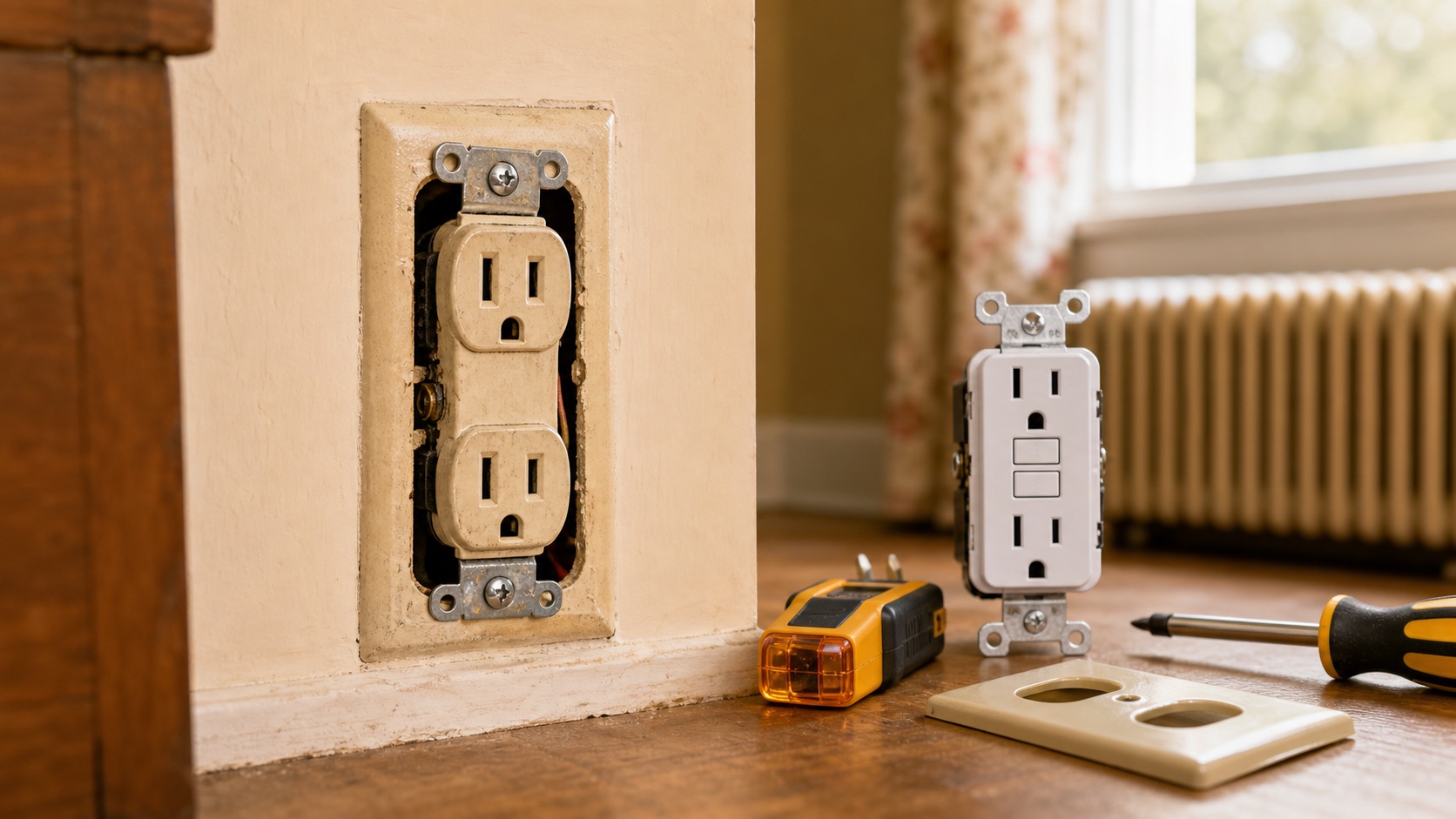
Two-prong outlets mean your wiring has no equipment ground — common in homes built before the 1960s — and while it’s not an immediate emergency, it leaves sensitive electronics unprotected and can be a shock hazard, so it’s worth fixing the right way. The good news: you usually have a code-approved option that doesn’t require rewiring the whole house. Here’s what ungrounded outlets mean, your real fix options, and the one “fix” you should never use.
Why the Ground Matters
The third (round) prong is a safety ground. If a fault sends current to a device’s metal case, the ground gives it a safe path and trips the breaker instead of energizing the case (and you). Without it:
- Shock risk if an appliance faults.
- No surge path — sensitive electronics (computers, AV) are unprotected; a surge protector needs a ground to work properly.
- Three-prong devices don’t fit safely — tempting people to use dangerous adapters.
Your Fix Options
| Option | Code-approved? | Notes |
|---|---|---|
| GFCI outlet (no ground) | ✅ Yes | Allowed fix; protects against shock; label “No Equipment Ground” |
| Run a ground wire | ✅ Best | True ground; more labor |
| Rewire the circuit | ✅ Best, costliest | Often paired with whole-house rewire |
| Cheater plug (3→2 adapter) | ❌ No | Defeats safety — don’t |
The GFCI option is the key one most homeowners don’t know: code allows replacing an ungrounded two-prong outlet with a GFCI (or a GFCI-protected downstream outlet), labeled “No Equipment Ground.” It protects people from shock, though it still doesn’t provide a true ground for surge protection.
What NOT to Do
- Never use a “cheater” 3-to-2 adapter to force a grounded plug in — it gives no ground and is a shock/fire risk.
- Don’t swap in a regular 3-prong outlet on ungrounded wiring — it falsely signals a ground that isn’t there (a code violation and a hazard).
Costs
| Fix | Typical cost |
|---|---|
| GFCI outlet install | $130 – $300 |
| Run a ground to one outlet | $150 – $500 |
| Rewire a circuit | $500 – $2,000+ |
| Whole-house rewire | $8,000 – $20,000+ |
If many outlets are two-prong, it often points to old wiring (knob-and-tube, early systems) — worth a broader look (knob-and-tube + insurance, when to rewire). Most of this is electrician work and may need a permit.
Frequently Asked Questions
Are two-prong outlets dangerous? They’re not an immediate emergency, but they indicate ungrounded wiring, which leaves you without the safety path a ground provides. That means a higher shock risk if an appliance faults and no proper protection for sensitive electronics. It’s worth upgrading, especially in kitchens, bathrooms, and where you use computers or expensive electronics.
Can I replace a two-prong outlet with a three-prong outlet? Not with a standard three-prong outlet on ungrounded wiring — that falsely implies a ground exists and is both a code violation and a hazard. The code-approved option is to install a GFCI outlet (or protect the outlet from an upstream GFCI) and label it “No Equipment Ground,” or to actually run a ground wire or rewire the circuit.
Does a GFCI outlet work without a ground? Yes. A GFCI protects against shock by detecting imbalances between the hot and neutral and cutting power, which doesn’t require a ground wire. That’s why code allows GFCIs as the fix for ungrounded outlets, labeled “No Equipment Ground.” Note it still doesn’t provide a true ground, so it won’t give surge protectors the grounding they need.
Why shouldn’t I use a cheater plug adapter? A 3-to-2 “cheater” adapter lets a grounded plug fit a two-prong outlet but provides no actual ground unless properly bonded (which it usually isn’t). That defeats the safety purpose, leaving you exposed to shock and giving surge protectors a false ground. It’s a hazard and not a code-compliant solution — use a GFCI or proper grounding instead.
How much does it cost to fix ungrounded outlets? Installing a GFCI outlet runs about $130–$300, running a ground to a single outlet $150–$500, and rewiring a circuit $500–$2,000+. A whole-house rewire (often the case with very old wiring) is $8,000–$20,000+. If most of your outlets are two-prong, have an electrician assess the wiring, since it may point to aging systems worth a fuller upgrade.
Last updated: June 17, 2026. Sources: ESFI on grounding and outlet safety; NFPA National Electrical Code on GFCI replacement of ungrounded receptacles; 2026 cost ranges per our electrical guides. Never defeat grounding with cheater adapters.