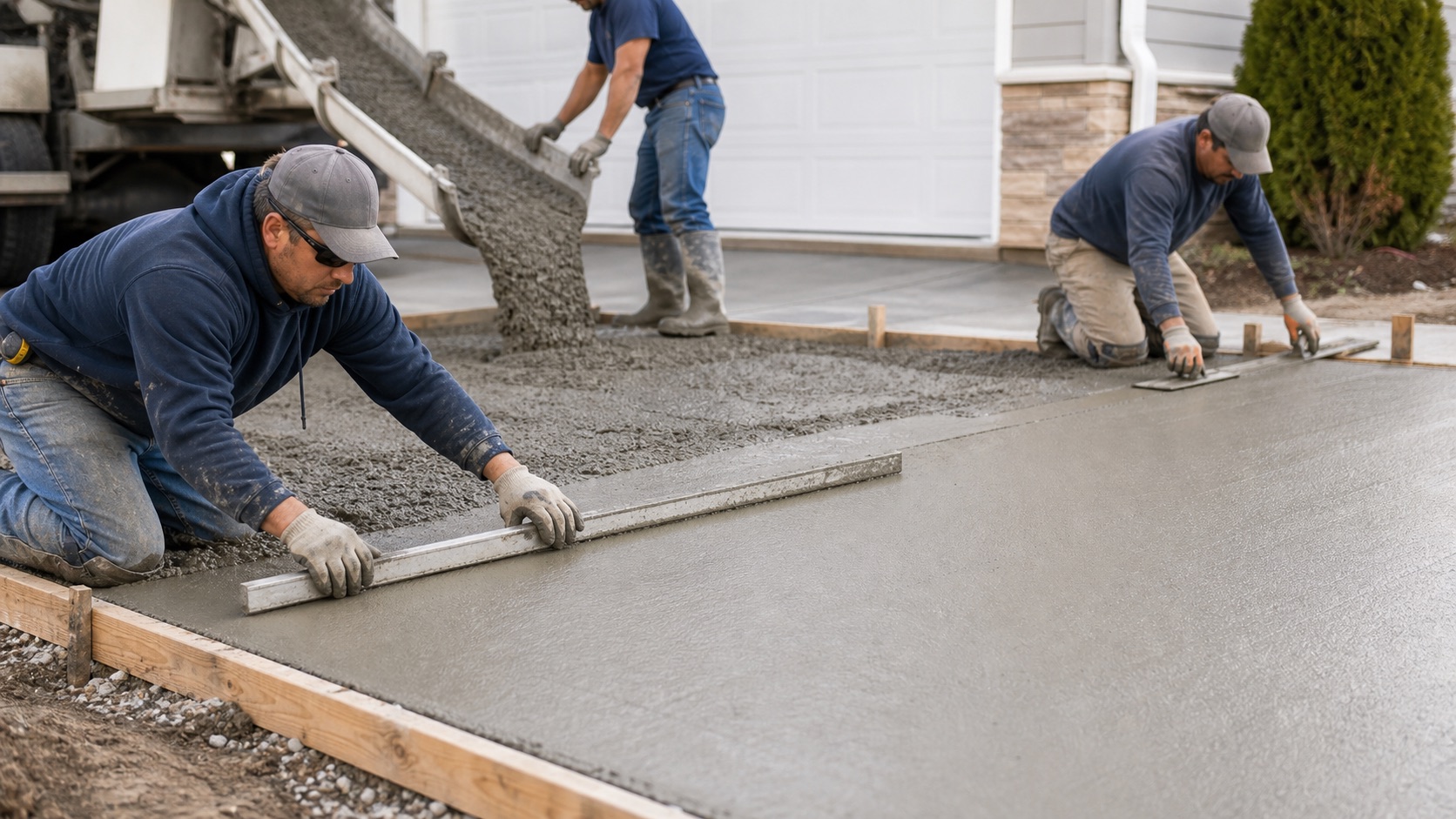
Concrete costs $125 to $200 per cubic yard for ready-mix material delivered, or $4 to $8 per square foot installed for a basic broom-finish project. With full site prep, reinforcement, and finishing, most residential work lands at $6 to $12 per square foot, while decorative finishes like stamping run $8 to $20 or more. This guide breaks down 2026 concrete prices by project, explains what actually drives the price, and shows where homeowners overspend.
How Much Does Concrete Cost Per Cubic Yard vs. Per Square Foot?
Contractors and suppliers quote concrete two ways: by volume (cubic yards of ready-mix delivered) and by finished area (installed price per square foot, which includes labor, forms, base, and finishing).
| Measure | 2026 Typical Cost |
|---|---|
| Per cubic yard (ready-mix, delivered) | $125 – $200 |
| Per cubic yard (high-PSI or specialty mix) | $150 – $250 |
| Per sq ft (basic, installed) | $4 – $8 |
| Per sq ft (full prep + reinforcement) | $6 – $12 |
| Per sq ft (stamped/decorative) | $8 – $20+ |
| Short-load fee (under 4–5 yards) | $50 – $150 per load |
One cubic yard covers roughly 80 square feet at 4 inches thick. A 20x20 patio at 4” needs about 5 yards — right at the threshold where many plants stop charging short-load fees.
Where these numbers come from: Material prices reflect 2026 ready-mix supplier quotes; installed prices include labor benchmarked against U.S. Bureau of Labor Statistics May 2025 wage data for cement masons and concrete finishers (median ~$24/hour nationally, significantly higher in major metros), plus overhead, equipment, and materials.
How Much Does Concrete Cost by Project?
| Project | Typical Installed Cost |
|---|---|
| Driveway | $4 – $15/sq ft |
| Patio | $6 – $16/sq ft |
| Slab (shed, garage, RV pad) | $5 – $12/sq ft |
| Sidewalk/walkway | $6 – $14/sq ft |
| Stamped concrete | $8 – $20/sq ft |
| Resurfacing existing concrete | $3 – $10/sq ft |
| Old concrete removal | $2 – $6/sq ft |
Regional labor and material costs swing these ranges meaningfully — see our city guides for concrete cost in Chicago and concrete cost in Denver for local pricing.
What Drives the Price of a Concrete Pour?
- Mix strength (PSI). Standard residential flatwork uses 3,000–3,500 PSI concrete. Driveways and garage slabs in cold climates often call for 4,000–4,500 PSI, which adds $10–$25 per yard. The American Concrete Institute publishes the design standards (ACI 332 for residential work) most contractors follow.
- Reinforcement. Welded wire mesh adds roughly $0.35–$0.75/sq ft; #3 or #4 rebar on a grid adds $1–$2.50/sq ft. Fiber-reinforced mixes add $10–$20 per yard.
- Finish. Broom finish is the baseline. Smooth trowel, exposed aggregate, integral color, staining, and stamping each step the price up — stamping alone can double a project.
- Site access and pumping. If the truck can’t back within reach of the pour, a line pump adds $400–$900 per day and a boom pump $800–$1,500. Wheelbarrowing concrete by hand adds labor hours fast.
- Base preparation. Excavation, grading, and compacted gravel base often account for 20–30% of the bill — and skimping here is the #1 cause of early cracking.
- Demolition. If you’re replacing a slab, add removal cost of $2–$6/sq ft.
Do You Need Air-Entrained Concrete in a Cold Climate?
If you live anywhere with freeze-thaw cycles — the upper Midwest, Mountain West, Northeast — the answer is yes for any exterior flatwork. Air-entrained concrete contains billions of microscopic air bubbles that give freezing water somewhere to expand, preventing surface scaling and spalling. The Portland Cement Association recommends 5–7% entrained air for exterior concrete in severe freeze-thaw exposure.
Air entrainment adds only a few dollars per yard, but contractors in markets like Chicago and Denver treat it as standard — if a low bid doesn’t specify an air-entrained mix and a 4,000+ PSI rating for your driveway, that’s a red flag, not a bargain.
Why Does Base Prep Matter More Than the Concrete Itself?
Concrete is only as good as what’s under it. A proper pour sits on 4–6 inches of compacted crushed gravel over graded, undisturbed soil. Skipping compaction or pouring over soft fill leads to settling, and a settled slab can’t be glued back — it needs concrete leveling (mudjacking or polyurethane foam) or full replacement. On expansive clay soils, poor prep can even telegraph movement to nearby structures; if you’re seeing related cracks in your home, see our foundation repair cost guide.
When comparing quotes, ask each contractor to itemize base depth, compaction method, and mix spec. The cheapest bid usually saves money underground, where you can’t see it — until it cracks.
How Can You Save on a Concrete Project?
- Get three itemized quotes and compare mix PSI, base depth, and reinforcement line by line — not just totals.
- Choose a broom finish and stain or stamp only high-visibility areas.
- Combine projects (driveway + walkway + patio) into one pour to spread mobilization and short-load fees.
- Schedule for mild weather. Pours in extreme heat or cold require additives and protection that cost extra and cure worse.
- Verify licensing and insurance before you sign — our contractor license verification guide shows you how, state by state.
Frequently Asked Questions
How much does concrete cost per cubic yard in 2026? $125–$200 per cubic yard delivered for standard 3,000–3,500 PSI ready-mix. Higher-strength, air-entrained, or fiber-reinforced mixes run $150–$250. One yard covers about 80 sq ft at 4 inches thick.
How much does it cost to pour a 20x20 slab? A 400 sq ft slab at 4 inches thick costs roughly $2,400–$4,800 installed with basic finish, or $4,000+ with thicker pours, rebar, and decorative finishes. See the full slab cost guide.
Is it cheaper to mix concrete yourself? Only for very small jobs (under ~1 cubic yard). Bagged concrete costs $4–$7 per 80-lb bag, and a yard takes about 45 bags — at that point ready-mix delivery is cheaper, more consistent, and meets ASTM C94 quality standards.
What PSI concrete do I need for a driveway? 3,500–4,000 PSI in mild climates; 4,000–4,500 PSI air-entrained in freeze-thaw regions, per ACI residential guidance.
How long does concrete last? Properly installed concrete lasts 25–50 years. Base prep, control joints, correct mix design, and periodic sealing matter more than any other factors.
Sources: U.S. Bureau of Labor Statistics, Occupational Employment and Wage Statistics (May 2025); American Concrete Institute; Portland Cement Association; ASTM International. National averages for informational purposes; always get a written, itemized quote from a licensed concrete contractor.